Winter Car Maintenance Guide: Wrenching When It’s Cold
Written and reviewed by the CarCultureHQ Editorial Team. See our Editorial Policy for sourcing and corrections.
Estimated Read Time: 11 minutes
Summary: Forget the generic listicles telling you to 'check your antifreeze.' You already know that. Winter car maintenance, when done right, is about preserving performance and stopping corrosion before it fuses your suspension. This guide covers the real decisions: storing your summer car, keeping your daily driver alive, and what actually matters when the temperature plummets.
The Winter Wrenching Cold Reality
I’m sitting here writing this in a garage that's starting to get pretty cold at night. The air is damp, my knuckles are scraped, and I’m about to drop a trans crossmember on a project. Why? Because winter car maintenance isn't a choice; it's the cost of admission for being a car enthusiast in a cold climate.
Generic advice? "Check your tire pressure." Thanks, Brenda. Real advice? "Your performance summer rubber is now dangerous plastic below 45 degrees, and you’re going to slide that clean E46 into a curb if you don't swap them."
We are fighting two different battles here. There is the preservation of the project car that gets stored, and the active battlefield of keeping your daily driver from turning into a pile of rust flakes. Let’s get real about both.
Join CarCultureHQ
Claim your free digital garage
Build your ride profile, log modifications, join a crew, and get your build in front of thousands of enthusiasts.
Create your free garageBattleground 1: Storing the Project Car (Passive Defense)
If you have a clean summer car, a dedicated track build, or a restoration, winter maintenance is about creating a protective capsule. Your goal is to seal it, stabilize it, and then walk away.
The single biggest mistake enthusiasts make is periodic starting. Do not start your car once a week to "circulate fluids." Unless you drive that car for 30 minutes at full operating temperature, all you are doing is introducing condensation into the oil, loading the cylinders with cold-start fuel, and never getting the exhaust hot enough to evaporate moisture. That condensation becomes acid. You are hurting the car.
1. Wash, Then Dry. Properly.
Before the covers go on, the car must be spotless. But here is the critical step: it has to be dry. A wet car trapped under a cover in a cold garage is an osmosis chamber for clear coat failure. Go for a final, aggressive drive. Get the brakes hot. Evaporate water from every crevice, window seal, and mirror housing.
2. Overinflate Tires
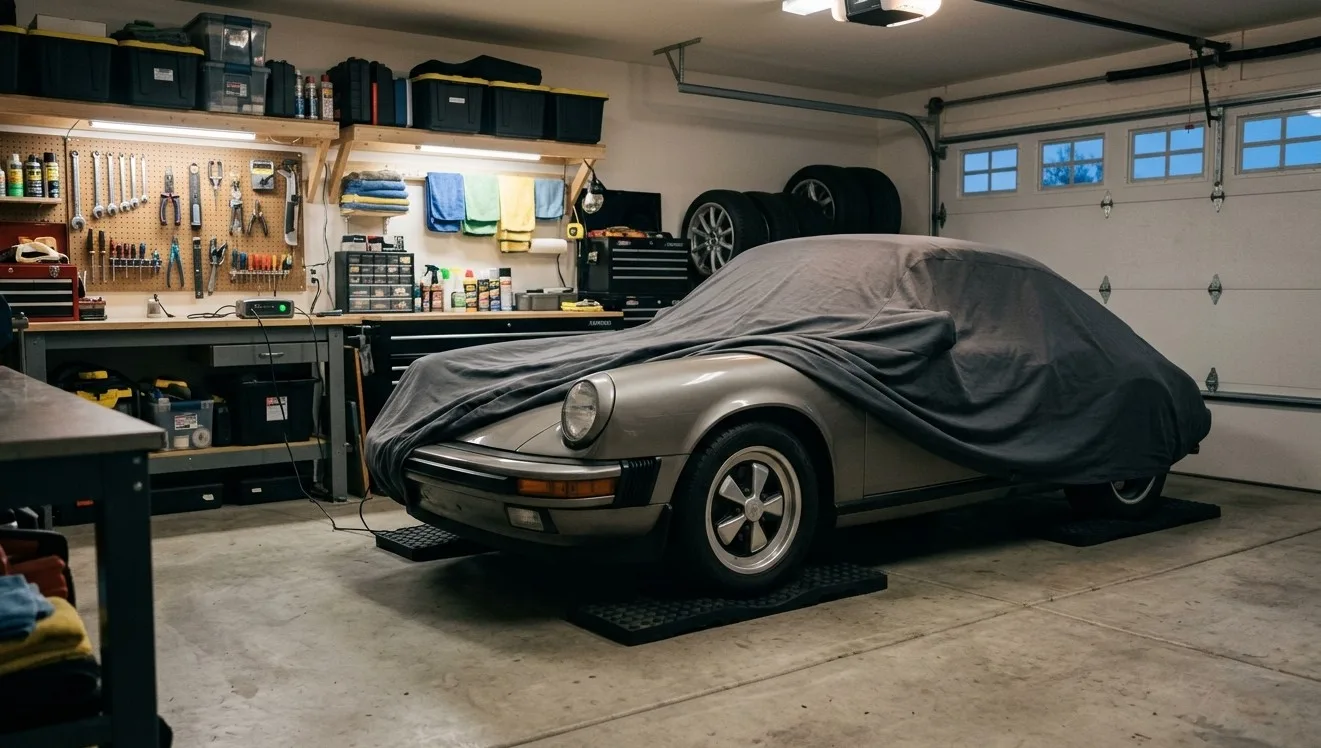
Flat spots are real. If the car will sit on concrete for months, set your tire pressure 10-15 PSI higher than standard. Concrete wicks moisture and cold. If you are paranoid, park the car on carpet squares or specialized tire cradles to add a thermal barrier.
3. Stabilize the Fuel and Oil
Gasoline degrades in 90 days. Ethanol-blended fuel absorbs moisture from the air. This moisture separation corrodes fuel pumps and clogs injectors.
The Move: Drive the car until the tank is low. Add a high-quality fuel stabilizer (like STA-BIL 360). Fill the tank to 95% full with fresh premium fuel. Drive it for another 15 minutes to get the stabilized fuel through the full system.
Oil: Cold oil sludge is real. If your oil is near the end of its life, change it right before storage. Acids form in used oil; you don't want that sitting in your crankcase for four months.
4. Kill the Electrical Load
A modern car has a parasitic draw (security systems, radio memory) that will kill a battery in three weeks of cold. Once a lead-acid battery goes completely flat in the cold, it sulfating and is usually garbage.
The Move: Disconnect the negative terminal. Or, if you have power in your garage, get a smart battery tender (a 'maintainer,' not a manual charger). Clip it on and let it do its job.
5. Seal the Envelope
Rodents need a warm home, and they love wire insulation.
The Move: Block the exhaust tips and the air intake scoop with steel wool or dedicated storage plugs. Lay dryer sheets in the interior and trunk (they hate the smell). Place Irish Spring soap (cut into chunks) around the perimeter. Check your standard mouse traps every few days.
Battleground 2: Preserving the Daily Driver (Corrosion War)
Now let's talk about the machine that actually has to face the brine. Winter car maintenance on a daily is an active, ongoing war against salt.
The salt they use on roads now (especially magnesium chloride brine) is far more sticky and corrosive than standard rock salt. It gets atomized into a dust that penetrates every bushing, seam, and electrical connector. Your job is physically separating the salt from the metal.
1. Fluid Film: Your New Best Friend
Simple water washing isn't enough. Water pushes salt into crevices. You need a physical, hydrophobic barrier between the metal and the salt dust.
The Move: Before the first snow, buy three cans of Fluid Film or Woolwax. Get the car in the air (use jack stands, never work under a jack alone). Spray every non-exhaust metal surface: suspension arms, subframes, brake lines (avoiding the rotors), the inside of fender arches, and the exposed chassis. Do this twice a year.
2. Washer Fluid Flush
The "all-season" fluid you have in your car now is likely only rated to 20F or 0F. When that hits 10F on the highway, it will flash-freeze instantly on your windshield when you spray it.
The Move: Buy a gallon of specialized -40F winter mix. Flush your entire existing reservoir by spraying it out. Re-fill with the winter mix. If you fail to do this, the fluid can freeze, cracking your reservoir tank or the pump itself.
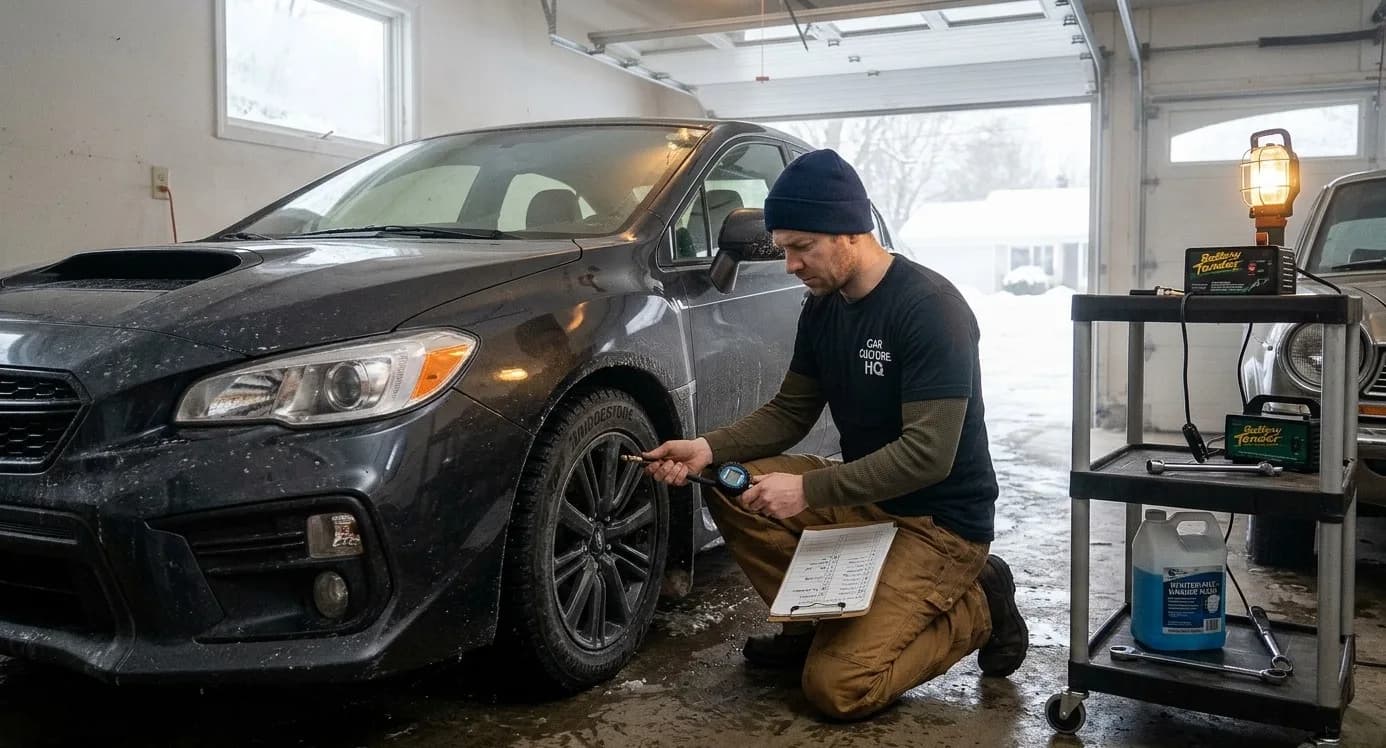
3. Weekly Tire Pressure Checks
Cold air is dense air. Physics dictates you lose roughly 1 PSI of tire pressure for every 10-degree Fahrenheit drop in ambient temperature. If you checked your pressure in October (60F) and it is now January (10F), your 35 PSI tires are now at 30 PSI. This causes uneven wear, sluggish handling, and poor fuel economy.
4. Battery Diagnostics (The Voltage Check)
A car battery loses 30% to 60% of its cranking power once temperatures drop below freezing, right when your cold engine oil (which is now thick sludge) needs maximum energy to turn over. If your battery is more than four years old, the cold will find its weak spot.
The Move: Do not wait for a slow crank. Get your battery professionally load-tested at any auto parts store (it’s free). A simple voltage check isn't enough; the load test is the real diagnostic.
Tires: The Compromise is Over
The final, crucial pillar of winter car maintenance isn't a check; it's a financial decision.
If you are running performance summer tires, they are lethal below 45F. The rubber compound hardens, turns into plastic, and loses all compliance. You will have near-zero grip even on dry asphalt. "All-season" tires are merely "compromise" tires. They do nothing well. In cold slush, they pack instantly and become slicks.
Tire Type | Rubber Compound Threshold | Dry Grip (Cold) | Snow/Ice Grip | Rain/Slush Grip |
Summer Performance | >45°F | Dangerous (Hard) | Zero | Dangerous |
All-Season | >20°F | Moderate | Poor | Moderate |
Winter/Snow (e.g., Blizzak) | <45°F (Optimum) | Good | Excellent | Excellent |
Winter tires are not just for snow. Their rubber compound (full of silica) remains soft and pliable below freezing, meaning they actually grip the road surface when standard tires cannot. The aggressive tread pattern (sipes) is designed to bite into packed snow and move water. If you live in a region that sees consistent freezing temperatures, winter tires are not an accessory; they are a safety component.
The Garage is Closed: A Final Thought
Winter maintenance is cold, wet, and annoying. But when spring finally breaks and you turn the key on that stored car, or you notice your five-year-old daily still doesn't have a spot of rust on the subframe, you’ll realize Brenda’s generic "check the antifreeze" advice was worthless. Real car culture is about doing the work that preserving the performance actually requires. Stop starting your stored car. Spray some Fluid Film. Buy the damn tires. We’ll see you at the first park-and-chill in April.
Join CarCultureHQ
Claim your free digital garage
Build your ride profile, log modifications, join a crew, and get your build in front of thousands of enthusiasts.
Create your free garageFrequently asked questions
What happens if I use standard oil in severe cold?
Standard multigrade oils (like 10W-30) turn thick and sludge-like in severe cold (0F or below). On startup, this thick oil takes much longer to reach critical engine components (like the valvetrain or turbocharger bearings), causing significant wear. If you live in a severe cold climate, your owner's manual likely recommends a 0W or 5W winter viscosity (e.g., 5W-30 instead of 10W-30) to ensure immediate oil flow when cold.
Is underbody car washing worth it in winter?
Yes, but only if done frequently. Simple pressure washing moves the salt around; it doesn't always neutralize it. Washing is passive defense. You need active defense (like the Fluid Film spray mentioned above). The best approach is combining a chemical barrier with frequent underbody rinses.
How often should I check my fluids in winter?
You should check critical fluids (oil, coolant level, washer fluid) at every fuel fill-up. Low coolant level in winter can lead to air pockets, which can freeze and crack an engine block or heater core. Cold oil consumes differently. Washer fluid is obviously used constantly. Be active.
Why did my check engine light come on during the first cold snap?
Cold weather often triggers false "check engine" lights. Dying batteries (due to low voltage) mess up sensor diagnostics. Sluggish oxygen sensors or evaporative emission components (which hate the cold) can trigger temporary codes. The move is to check the battery voltage first. Clear the code, drive it for a few cycles, and see if it returns once the system is truly warm.

Comments
Join the conversation on Winter Car Maintenance Guide: Wrenching When It’s Cold. Keep it civil — admins moderate reports.
Loading comments…