The Ultimate Guide to Getting Started in Track Day Racing

Taking your road car to the racetrack for the first time can feel overwhelming. This guide cuts through the elitist jargon to show you exactly how to prep your car, handle your first HPDE event, survive tech inspection, and get through your rookie track weekend without breaking your car or your bank account.
Stop Overthinking and Get on Track
Most car people spend years saying they are going to take their build to the track. They talk about it at weekend meets, order suspension parts online, and watch lap records on YouTube. Then they talk themselves out of registering because they think their car is not fast enough, not low enough, or not ready.
Here is the truth: your car is probably fine right now.
You do not need a gutted interior, a massive wing, or 500 wheel horsepower to start. High Performance Driver Education (HPDE) exists specifically to take street drivers and teach them how to handle a car at speed in a controlled environment.
Join CarCultureHQ
Claim your free digital garage
Build your ride profile, log modifications, join a crew, and get your build in front of thousands of enthusiasts.
Create your free garageStep 1: Essential Car Prep (Forget Power Upgrades)
When you take a road car onto a road course, heat is your primary enemy. Your engine runs at wide-open throttle for 20 minutes straight, and your brakes handle hard stops from 100+ mph lap after lap.
Skip the intake and exhaust upgrades for a minute. Focus entirely on heat management and safety:
1. Flush Your Brake Fluid
Stock DOT 3 or DOT 4 brake fluid boils easily when calipers absorb track heat. When fluid boils, it turns to gas, and your pedal sinks straight to the floorboard. Flush your system with high-temp fluid like Motul RBF 600 or Castrol SRF a week before the event.
2. Check Pad Thickness and Rotor Condition
Make sure your brake pads have at least 50% to 70% friction material remaining. Street pads will wear down twice as fast on track. Ensure your rotors are free of severe cracks or deep grooves.
3. Inspect Tires and Set Pressures
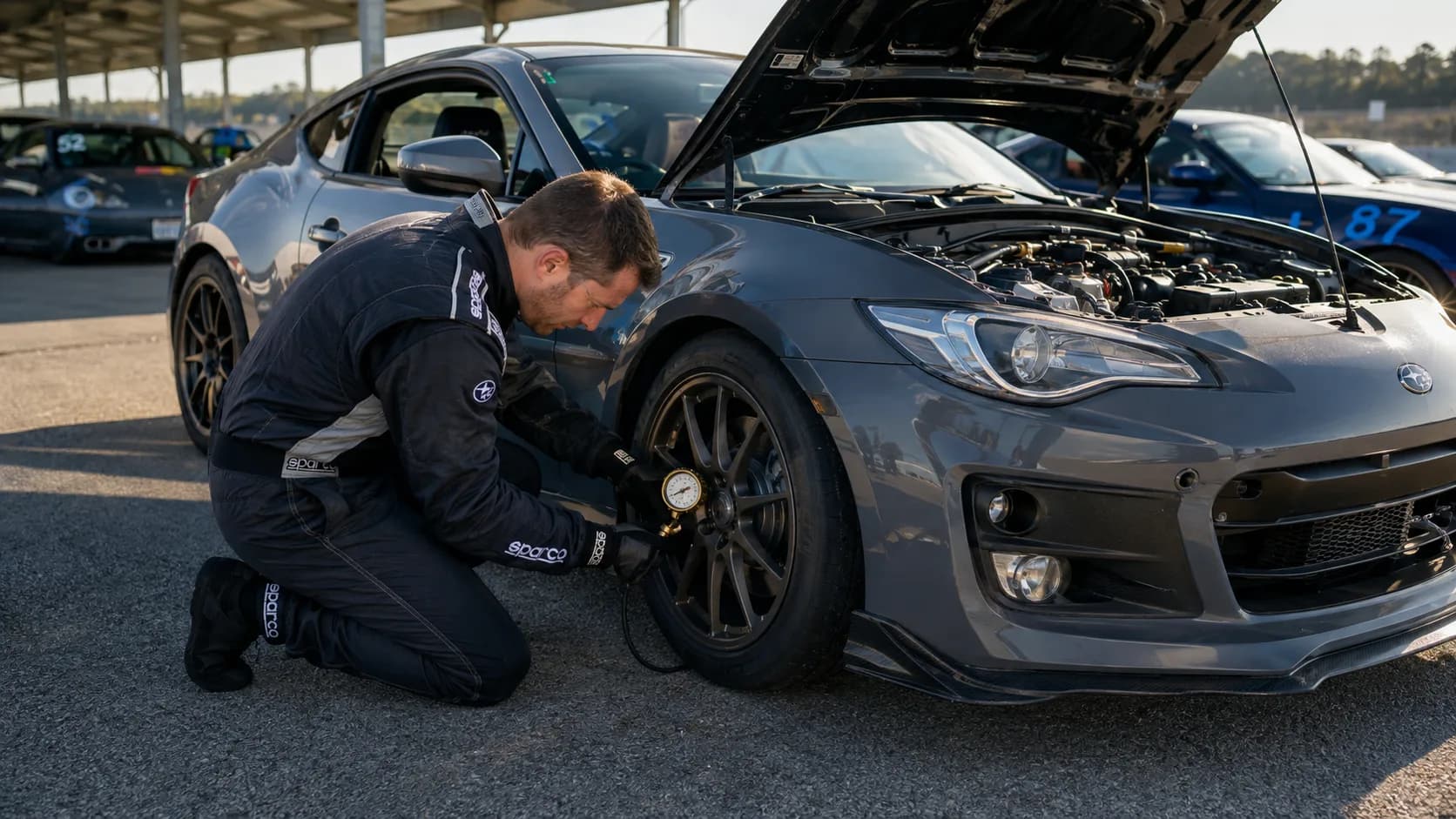
You do not need expensive 200-tw race tires for your first event. Regular performance street tires are better because they squeal loudly when losing grip, giving you clear audio feedback before you break traction. Check your tire date codes and bring a reliable tire pressure gauge.
4. Fix Leaks and Secure Loose Items
Tech inspectors will deny your registration if your engine drops oil, coolant, or power steering fluid onto the track surface. Inspect your valve cover gaskets and drain plugs.
Step 2: What to Pack in Your Track Bag
Showing up unprepared makes your morning stressful. Pack these basics in a storage bin the night before:
Snell SA2020 Helmet: Check your organization's rules. Most track day groups require a Snell SA-rated helmet rather than a motorcycle helmet.
Torque Wrench and Socket: Check your wheel lug nuts after every session once the wheels cool down.
Tire Pressure Gauge and Foot Pump: Cold tire pressures rise 4 to 8 PSI as tires heat up on track. You will need to bleed air out between sessions.
Engine Oil and Coolant: High-RPM driving burns oil. Check your dipstick after every session and keep a spare quart nearby.
Painters Tape: Used to tape off your glass headlights and create your car numbers on the doors.
Water, Snacks, and Folding Chair: Physical fatigue causes mental mistakes. Stay hydrated throughout the day.
Step 3: What Your First Event Actually Looks Like
When you arrive at 7:00 AM, the routine follows a specific structure:
Check-In and Tech Inspection: Unload everything from your car, including floor mats, spare tire, and glovebox clutter. Park in your pit space and pull up to the tech line.
Drivers Meeting: Everyone gathers for safety instructions, flag explanations, and track condition updates.
Classroom Sessions: Novice drivers spend time with lead instructors learning racing lines, apex points, braking zones, and flag meanings.
On-Track Sessions: You will get four or five 20-minute sessions. In the novice group, an experienced instructor sits in your passenger seat, talking you through turn-ins and guiding your passing point-bys.
Step 4: Track Etiquette and the Golden Rules
Novice track days are not races. There are no trophies, no timing transponders required, and zero reason to dive-bomb someone into a turn.
Respect the Point-By: Passing in novice groups happens only on specified straightaways when the driver ahead extends a hand out the window pointing to the side they want you to pass on.
Watch the Corner Stations: Flag marshals are your eyes around blind corners. Yellow flags mean slow down and no passing; red flags mean stop safely immediately; black flags mean pull into the pits to talk to officials.
Check Your Ego at the Gate: The fastest way to ruin a weekend is trying to keep up with a driver on slick tires when you are still learning line geometry.
Join CarCultureHQ
Claim your free digital garage
Build your ride profile, log modifications, join a crew, and get your build in front of thousands of enthusiasts.
Create your free garageFrequently asked questions
Do I need a dedicated sports car to start track day driving?
No. You can take almost any healthy daily driver to a beginner HPDE event, provided it passes basic safety tech inspection and is not a high-center-of-gravity vehicle like a truck or tall SUV.
What helmet rating do I need for a track day?
Most recognized organizations (such as NASA or SCCA) require a Snell SA2015 or SA2020 rated helmet. Motorcycle Snell M helmets are usually not permitted on road courses due to differing impact and fire-resistance standards.
Will my regular auto insurance cover my car at a track day?
Standard auto insurance policies almost always exclude coverage on closed-course racetracks, even during non-competitive driving events. Purchasing track day insurance from specialized brokers covers physical vehicle damage during the event.
How much does a typical beginner track weekend cost?
Registration fees generally range from $250 to $500 per day. When you factor in fuel, high-temp brake fluid, helmet purchase, and minor tire wear, plan for an all-in budget of around $600 to $900 for your first weekend.


Comments
Join the conversation on The Ultimate Guide to Getting Started in Track Day Racing. Keep it civil — admins moderate reports.
Loading comments…